
Réutilisation pour une seconde vie : Étude de cas sur la réutilisation rénovée
Le bâtiment original de 24 x 64 pieds a été construit par Modern Building Systems en 1996 pour servir de garderie au Northwest Regional Educational Service District (ESD) à Forest Grove, dans l'Oregon. En 2016, le bâtiment n'était plus nécessaire et Modern Building Systems en a fait don à la section locale d'Habitat for Humanity. Modern Building Systems a acheté et enlevé le bâtiment sans frais pour l'ESD. Il a ensuite été transformé en une magnifique garderie récemment rénovée pour permettre à Family Nurturing Center d'étendre ses services en tant que campus satellite à Phoenix, dans l'Oregon. Le bâtiment abrite désormais des services de garde pour 28 enfants et familles.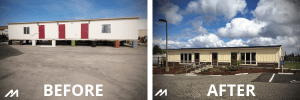
L'espace nouvellement rénové de la crèche comprend deux salles de classe, des toilettes pour hommes et pour femmes, un bureau et une cuisine. Modern a travaillé avec l'architecte Brian Westerhout, membre du conseil d'administration du Family Nurturing Center, pour réaménager le bâtiment afin qu'il réponde aux besoins et aux souhaits de la garderie. Des murs supplémentaires ont été installés près des toilettes et le couloir entre les salles de classe a été élargi pour permettre une meilleure accessibilité. Les anciennes fenêtres ont été remplacées par de grandes fenêtres en vinyle de qualité supérieure de 8/0 x 6/0 afin d'apporter plus de lumière dans la pièce. Le revêtement de sol en marmoleum et les meubles de rangement ajoutent un attrait visuel supplémentaire à l'ensemble du bâtiment. Les nouvelles caractéristiques extérieures comprennent : des couleurs vives et personnalisées de bardage en fibre de ciment et de garnitures. La toiture et les portes en métal creux soudé ont également été rénovées.
Les matériaux du constructeur d'origine ont été utilisés dans la mesure du possible. En utilisant la structure d'origine autant que possible, on a réduit la quantité de déchets de construction et de démolition dans les décharges. En fait, le client a recyclé tout un bâtiment modulaire. Une toute nouvelle unité mécanique au gaz Bard à haut rendement a été installée sur le bâtiment pour le moderniser.
Le Family Nurturing Center est une organisation à but non lucratif qui fait partie de la réponse innovante et globale de l'Oregon pour soutenir les enfants et les familles en crise et qui fonctionne donc avec des budgets très serrés. Modern, en collaboration avec des entrepreneurs locaux, a accordé des remises et des dons pour faire de ce projet une réalité. En utilisant un bâtiment d'occasion et en le rénovant, le client a économisé des milliers de dollars par rapport à un bâtiment neuf de même conception et de mêmes spécifications.
Cet article a été initialement publié dans le magazine Modular Advantage - quatrième trimestre 2018 paru en novembre 2018.
Plus de Modular Advantage
From Model to Machine: Why Modular Scale Is Becoming a Software Problem, not a Material One
For modular manufacturers that have already secured demand and repeatable volume, the next major constraint may no longer be forming capacity itself. Increasingly, it is the continuity of the information feeding that capacity.
Who Will Define Modular Products for AI?
Artificial intelligence is making building configurators easier and less expensive to create. This makes urgent manufacturers’ need portable product definitions, stable identities, and shared interfaces regardless of how others’ software is produced.
From BIM to Robotic Production: A Digital Workflow for Customized Components in Volumetric Modular Construction
For volumetric modular manufacturers, the value of this workflow is not simply the use of robotics. Its real value is continuity.
Helping Build a Common Framework for Modular Construction in Canada
Canada’s modular construction sector continues to gain momentum, but scaling it successfully will depend on shared expectations across design, manufacturing, approvals, and project delivery. CSA Z251 helps provide that common foundation.
Edges, Exits & Equipment: A Modular Builder’s Guide to Rooftop Access
Rooftop access belongs in the factory design. Before the modules ship, the project team should identify each route’s users, confirm applicable requirements, coordinate with the roof system and structure, and assign responsibility.
When Timber Production and Modular Construction Share One System
As demand for multifamily and workforce housing continues to outpace what conventional construction timelines can deliver, models that reduce the number of handoffs between structural fabrication and modular assembly are likely to draw more attention.
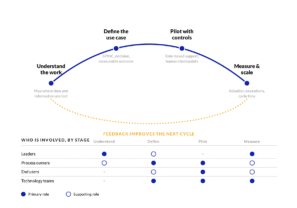
Your AI Strategy Is an Enablement Strategy
Tools will change. Teaching employees only the steps in one platform creates a narrow capability. Involving them in problem definition, process mapping, data assessment, controls, and measurement gives the organization a way to improve its systems as technology evolves.
By-Right Permitting: The Missing Lever for Scaling Modular Multifamily
Modular has already proven it can outperform traditional building methods on speed and cost per unit. The next frontier is outside the factory in the front end of the process, where projects either clear a path to construction or get stuck in review.
Remote Inspections and The Future of Factory Oversight
Remote inspection is becoming a practical part of modular construction oversight. Its value is greatest when it is used selectively, governed by clear procedures, and supported by complete traceability.
Reimagining Dry-In: How a Temporary-to-Permanent Roofing Strategy Mitigates Risk Between Modular Installation and Final Roof Construction
As volumetric modular projects continue to increase in scale and complexity, the Temporary-to-Permanent FiberTite Roof System represents an example of how traditional trade scopes can be reimagined through Design for Manufacturing and Assembly (DfMA) principles.