
Silver Creek Industries - École à charte
Grâce à l'approche de conception-construction utilisée pour ce projet, Silver Creek a pu collaborer directement avec le client sur les considérations de conception pendant la phase conceptuelle du projet afin de s'assurer que les systèmes de construction modulaire sélectionnés soutiendraient l'intention de la conception. Le projet consiste en une structure de trois étages qui abrite l'ensemble du campus d'une école à charte et les espaces fonctionnels connexes. Le bâtiment comprend 18 salles de classe, une cuisine, un espace polyvalent, des espaces administratifs, des couloirs intérieurs, un ascenseur intérieur et des escaliers intérieurs.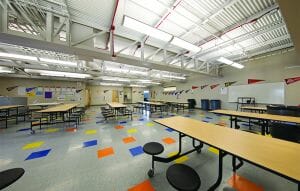
L'extérieur du bâtiment est en plâtre avec une palette de couleurs vives et des systèmes de vitrage en aluminium. Le bâtiment fini reflète les efforts coordonnés de tous les membres de l'équipe pour offrir une expérience axée sur la conception.
En raison de la complexité et de l'ampleur du projet, la possibilité d'effectuer les travaux en usine a permis de réduire considérablement les coûts et d'améliorer les mesures de contrôle de la qualité. Des modules plus grands que la normale ont été utilisés pour maximiser l'étendue des travaux en usine. L'emplacement judicieux des toilettes a permis de fermer ces espaces de tous les côtés à l'intérieur d'un seul module et de quitter l'usine complètement achevé.
Les espaces qui ne pouvaient pas être fermés en raison de leur taille ou de leur emplacement ont été partiellement finis en usine et, dans la mesure du possible, les finitions restantes ont été prédécoupées afin de minimiser la durée des travaux sur le site. Le système de distribution électrique a été conçu pour utiliser des conducteurs et des conduits de plus grande taille afin de réduire le nombre de connexions électriques effectuées sur le terrain. Dans la mesure du possible, les gaines ont été conçues pour être installées dans un seul module, ce qui a permis d'éliminer les raccordements horizontaux sur le terrain.
Cet article a été publié à l'origine dans le magazine Modular Advantage - deuxième trimestre 2018 publié en février 2018.
Plus de Modular Advantage
MBI Town Halls 2026: Reflections from Boston
By the end of 2026 MBI’s Government Affairs team will have traveled over 6,000 air miles to bring Town Hall events to five different cities in two countries.
Mind the Gap: The Interface Between Onsite and Offsite Construction
Every design for manufacture and assembly (DfMA) project — modular, mass timber, or panelized — is really two projects joined at a seam. One is built in a controlled factory to millimeter tolerances; the other in the field, in weather, to the looser tolerances of poured concrete and human hands. Between them sits an interface: where the factory’s precision meets the site’s reality.
Rules, Rails & Repeatability: Applying DfMA to Modular Healthcare
DfMA offers several advantages for healthcare projects, with faster delivery among the most valuable. Schedule matters when building new facilities, expanding campuses, renovating existing space or bringing care closer to communities that need it.
Precision and Possibility: Demands of DfMA and What Modular Mass Timber Makes Possible
Mass timber does not automatically create an efficient modular building. Its precision makes early coordination more important: fabricated components will accurately reproduce both the team’s solutions and its mistakes. The material’s advantages are realized only when supported by an equally precise design and delivery process.
Catch It in the Factory, Not in the Field: Smarter Testing for Modular Builds
Integrating watertightness and airtightness testing into factory workflows transforms quality assurance from a reactive process into a proactive commissioning strategy. It ensures that every module shipped is field ready and resilient for transportation while also supporting the ability of the modular construction industry to make buildings better.
Modular Construction Contracts: Key Considerations for Successful Canadian Projects
Starting a modular project with a well-developed contract protects both the owner and the contractor. It will help keep the project on track and on budget, and it will improve quality from the factory floor to final installation on-site.
Modular by Design: Turning Architecture into a Manufacturing System
Modular construction is often presented as a faster way to build. Speed, however, is only one part of its value. The larger opportunity is to create a coordinated design and production system that improves quality, reduces uncertainty, and allows a building to move efficiently from concept design through manufacturing, transportation, installation, and completion.
Repeatability Begins with Trust: What Alora at Dry Creek Reveals About Scaling Modular Housing
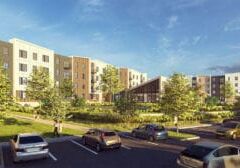
Alora at Dry Creek, a 329-unit, multifamily community comprising five four-story buildings in Centennial, Colorado, demonstrates how repeatable design, standardized manufacturing and early collaboration can work together to create a model that is not only faster to deliver, but easier to replicate across future projects.

T.R. Arnold: The Art of Third-Party Inspections
T.R. Arnold (TRA), a third-party inspection company in Elkhart, Indiana, contracts with modular manufacturers across the US. Manufacturers register with each state to which they intend to send their modules and may be required to hire a third-party inspection company.
Creating an ‘Ecosystem for Innovation:’ 50+ Years of Modular Construction Oversight in Virginia
Virginia’s modular building program began in 1973, with the implementation of the Virginia Industrialized Building Unit and Mobile Home Safety Regulations. Now it’s leading the country in modular code adoption.