
Leçons tirées de la carrière : Entretiens avec des professionnels de l'industrie de la construction modulaire

Heather Packard est directrice du développement professionnel et de la main-d'œuvre pour le Modular Building Institute.
Quelles leçons les professionnels de l'industrie en milieu de carrière et les vétérans ont-ils tirées au cours de leur carrière ? Comment l'industrie de la construction modulaire commerciale a-t-elle évolué au fil du temps, que doit-il se passer pour que l'industrie continue à se développer et qu'est-ce qui les incite à s'investir ?
Heather Packard, directrice du développement professionnel et de la main-d'œuvre de MBI, s'est entretenue avec plusieurs professionnels du secteur pour répondre à ces questions.
Comment l'industrie de la construction modulaire a-t-elle évolué depuis que vous y êtes entré ?
"Les chiffres ne mentent pas. Je suis entré dans l'industrie modulaire en 2011, lorsque la part de marché était inférieure à 2 %. En 2023, la part de marché a plus que doublé pour atteindre 6,64 %. À la base, le changement le plus apparent est la croissance. Dans le cadre de cette croissance, j'ai vu l'industrie changer ou s'adapter pour répondre aux besoins de notre société. Au début de ma carrière, l'industrie modulaire était relativement spécialisée et n'était pas utilisée comme technique de résolution des problèmes. J'ai vu la construction modulaire répondre aux besoins des sans-abri et des logements abordables, des soins de santé, de la main-d'œuvre et même des logements temporaires grâce à la capacité de l'industrie à produire des temps de construction accélérés et des solutions non permanentes. Le plus grand changement que j'ai observé est le passage d'un marché de niche à une technique de construction courante".
- Richard Chiavetta, directeur de l'architecture et de l'ingénierie, R&S Tavares Associates
"Il y a dix ans, l'utilisation d'éléments préfabriqués ou modulaires était quelque chose que nous devions minimiser ou décrire différemment aux clients et aux prospects. Depuis, j'ai constaté un changement radical dans la perception des avantages de la modularité, au point que la conception et le développement de projets qui intègrent ces éléments sont désormais un argument de vente de premier plan."
- Sara-Ann Logan, vice-présidente de la conception, Volumetric Building Companies
"J'ai un point de vue unique sur l'évolution du secteur, car je travaille dans le domaine de la technologie. Plus précisément, la production automatisée. J'ai vu beaucoup de nouveaux acteurs entrer dans la mêlée, ainsi que des avancées significatives en matière d'innovation. Comme c'est le cas pour l'utilisation, il y a encore beaucoup de croissance et de développement à venir, mais les progrès réalisés à ce jour sont prometteurs".
- Cooper Lane, vice-président des ventes, Reko International Group Inc.
"Lorsque nous avons fondé ProSet il y a près de dix ans, la construction modulaire était très répandue sur le marché des maisons individuelles, mais son utilisation était extrêmement limitée pour les bâtiments multifamiliaux et d'accueil à grande échelle. Il n'y avait que quelques fabricants modulaires qui construisaient de grands bâtiments permanents à plusieurs étages. Ce segment de l'industrie de la construction étant confronté à des budgets plus importants et à des durées plus longues, de nombreux promoteurs se sont tournés vers la solution modulaire, ce qui a entraîné la mise en service de dizaines de nouvelles usines pour répondre à cette nouvelle demande".
- Scott Bridger, vice-président, ProSet, Inc.
"Lorsque j'ai commencé à travailler dans ce secteur en 1983, il s'agissait de concessionnaires locaux et régionaux. Il n'y avait pas vraiment de sociétés nationales, et encore moins de sociétés internationales. Le secteur était essentiellement constitué d'une flotte de location de remorques de chantier. Chaque décennie a apporté des changements considérables, certains bons, d'autres moins bons, dans le secteur. Mais là où nous nous trouvons aujourd'hui, je ne voudrais pas être ailleurs. Le secteur est prêt à exploser pour ceux qui veulent prendre le temps d'apprendre et de se former. Si les bons partenaires sont réunis avec les mêmes objectifs et la même motivation, des choses extraordinaires peuvent être réalisées et le seront.
- John Buongiorno, vice-président de la division modulaire d'Axis Construction Corp.
Que faut-il faire pour que le secteur continue à se développer ?
"La poursuite des investissements dans l'automatisation et dans des moyens de production plus modernes permettra à l'industrie de se rapprocher des normes en vigueur dans d'autres pays plus industrialisés. Avec de meilleurs moyens de fabrication, nous pouvons continuer à faire croître le pourcentage d'utilisation. Avec des processus de fabrication et des moyens de production appropriés, l'industrie deviendra plus efficace, réduira les coûts de production, diminuera la dépendance à l'égard de la main-d'œuvre qualifiée et continuera à faire évoluer l'aiguille vers la préférence pour ce mode de construction".
- Cooper Lane, Vice-président des ventes, Reko International Group Inc.
Vous voulez en savoir plus ?
Regardez ces vidéos pour en savoir plus sur les rôles professionnels au sein de l'industrie et sur les moyens d'inspirer la prochaine génération de talents de l'industrie à prendre le relais.
"Je pense qu'un effort de collaboration de la part de toutes les parties concernées permettra de mener à bien les projets. Rien ne ralentira plus la croissance que l'absence de production. Le secteur doit travailler ensemble pour s'assurer que nous soutenons les affirmations selon lesquelles la construction modulaire est une meilleure façon de construire. Nous pouvons y parvenir en formant les nouveaux arrivants dans le secteur, qu'ils soient jeunes ou moins jeunes. Nous devons créer des opportunités pour que les jeunes entrent sur le marché du travail en étant formés et engagés dans la construction modulaire et en s'investissant dans son succès. Nous devons également créer des opportunités pour que des personnes venant d'autres secteurs entrent sur le marché du travail parce que nous offrons des méthodes de construction meilleures et différentes. Si nous aidons à former ces nouveaux arrivants et à les maintenir engagés, notre industrie continuera à se développer en réalisant des projets avec succès".
- Richard Chiavetta, directeur de l'architecture et de l'ingénierie, R&S Tavares Associates
"Nous avons besoin d'une campagne de marketing concertée qui décrive au marché des consommateurs et des clients comment nous voulons qu'ils interagissent avec nous pour réussir. Il s'agit notamment de définir une terminologie que nous pourrons adopter universellement afin de minimiser toute confusion ou différence d'attentes de la part du marché. Nous avons également besoin d'un effort de développement de la main-d'œuvre à grande échelle pour soutenir les compétences traditionnelles et nouvelles qui ont été créées par les progrès réalisés au cours des deux dernières décennies dans les domaines de la conception, de la fabrication et de la construction".
- Sara-Ann Logan, vice-présidente de la conception, Volumetric Building Companies
"Une plus grande capacité de production sera nécessaire pour continuer à passer de la construction conventionnelle à la construction modulaire. La normalisation est l'une des mesures clés nécessaires à la croissance de l'industrie manufacturière. Plus une usine est efficace dans sa production, plus elle est rentable. Il existe deux clés pour atteindre l'efficacité. Premièrement, la communauté des concepteurs et des développeurs doit permettre la normalisation, c'est-à-dire s'abstenir d'exiger la personnalisation. Deuxièmement, les codes de construction doivent être normalisés afin que chaque projet ne soit pas soumis à des codes différents d'un bout à l'autre du pays".
- Scott Bridger, vice-président, ProSet, Inc.
"L'éducation de toutes les parties et des parties potentielles est primordiale et permettra de continuer à stimuler la croissance de l'industrie.
- John Buongiorno, vice-président de la division modulaire d'Axis Construction Corp.
Qu'est-ce qui vous motive personnellement ?
"Il y a tellement de problèmes à résoudre, notamment l'inefficacité et le manque inhérent d'abordabilité et d'accès approprié au logement. De nouvelles idées, méthodes et processus pour résoudre cette crise mondiale me donnent envie de venir travailler tous les jours."
- Sara-Ann Logan, vice-présidente de la conception, Volumetric Building Companies
"À plus grande échelle, l'idée de faire partie d'un secteur en pleine croissance et d'investir dans sa réussite me tient en haleine. Chaque jour est différent. Chaque projet est différent. La possibilité de créer et de résoudre des problèmes avec mon équipe me motive."
- Richard Chiavetta, directeur de l'architecture et de l'ingénierie, R&S Tavares Associates
"Travailler dans le domaine de l'automatisation m'a permis de me réengager dans ma carrière. J'ai le sentiment que le travail que nous effectuons chez Reko Automation apporte un changement dans ce monde. Nous trouvons de meilleures façons de construire des logements et d'améliorer la construction. Nous nous attaquons à des problèmes tels que la crise de l'emploi et la pénurie de logements, et nous essayons de rendre le logement plus accessible.
- Cooper Lane, vice-président des ventes, Reko International Group Inc.
"Essayer de trouver le prochain projet que personne d'autre ne veut ou ne pense pouvoir réaliser me tient en haleine. J'ai un jour rêvé de réaliser un projet d'un million de dollars, et maintenant j'attribue des contrats de sous-traitance d'une valeur de plusieurs millions de dollars.
- John Buongiorno, vice-président de la division modulaire d'Axis Construction Corp.
"J'ai passé les premières décennies de ma carrière dans la construction conventionnelle. En 2014, risquant l'épuisement professionnel, j'ai eu la chance d'être introduit dans le monde modulaire par Matt Mitchell. Il a vu l'avenir de l'industrie modulaire commerciale à grande échelle, et en le rejoignant pour fonder ProSet, mon énergie pour la construction a été rajeunie. Dix ans plus tard, je suis chaque jour très enthousiaste à l'idée de participer à ce que l'on ne peut appeler qu'une révolution de la construction.
- Scott Bridger, vice-président, ProSet, Inc.
Quelles leçons avez-vous tirées au cours de votre carrière ?
"Créez des liens. Développez votre réseau. Aidez les autres à établir des contacts, mais nouez également des relations durables avec ces contacts, dans et autour du secteur. J'ai constaté que plus je construis de relations et plus je suis capable de me connecter avec les gens (et de connecter les gens), plus ma carrière est couronnée de succès."
- Richard Chiavetta, directeur de l'architecture et de l'ingénierie, R&S Tavares Associates
"Soyez patient. Soyez persévérant. Soyez prêt à changer d'avis. Rien n'arrive quand on le veut, de la manière exacte dont on le veut et sans compromis. Le fait de savoir quand plier et faire des compromis m'a été très utile dans ma carrière.
- Sara-Ann Logan, vice-présidente de la conception, Volumetric Building Companies
"Avant tout, rencontrez et apprenez à connaître le plus grand nombre possible de personnes partageant les mêmes idées. Les relations sont essentielles à la réussite. Faites preuve d'humilité, d'empathie et de sincérité. Concentrez-vous sur ce qu'il faut faire et ne lâchez rien. Si vous avez l'impression que c'est facile, c'est probablement que vous vous y prenez mal. Rien ne vient sans un travail acharné.
- Cooper Lane, vice-président des ventes, Reko International Group Inc.
"Il y a une chose que je n'avais pas comprise au début de ma carrière : pour être un innovateur dans un secteur en mutation, il est non seulement important de penser de manière créative et "hors des sentiers battus", mais aussi de savoir écouter. Trop souvent, nous nous concentrons sur ce que nous considérons comme la clé pour atteindre nos propres objectifs, mais si nous prenons du recul et que nous examinons la situation dans son ensemble pour voir ce qui permettra à l'ensemble du secteur de réussir, notre pièce du puzzle en bénéficiera nécessairement. Tous les bateaux montent avec la marée, comme on dit.
- Scott Bridger, vice-président, ProSet, Inc.
"La plus grande leçon que j'ai apprise est qu'il n'y a pas de limites à ce que nous pouvons faire dans ce secteur. Bien que la constructibilité de certains types de bâtiments pose certains problèmes, si une équipe est motivée pour résoudre un problème, une solution peut toujours être trouvée."
- John Buongiorno, vice-président de la division modulaire d'Axis Construction Corp.
Plus de Modular Advantage
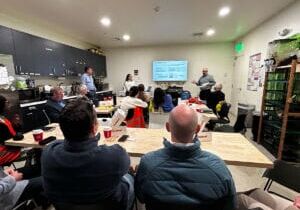
MBI Town Halls 2026: Reflections from Boston
By the end of 2026 MBI’s Government Affairs team will have traveled over 6,000 air miles to bring Town Hall events to five different cities in two countries.

Mind the Gap: The Interface Between Onsite and Offsite Construction
Every design for manufacture and assembly (DfMA) project — modular, mass timber, or panelized — is really two projects joined at a seam. One is built in a controlled factory to millimeter tolerances; the other in the field, in weather, to the looser tolerances of poured concrete and human hands. Between them sits an interface: where the factory’s precision meets the site’s reality.
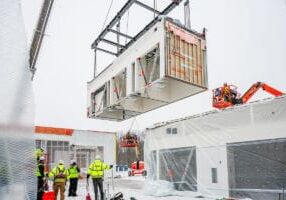
Rules, Rails & Repeatability: Applying DfMA to Modular Healthcare
DfMA offers several advantages for healthcare projects, with faster delivery among the most valuable. Schedule matters when building new facilities, expanding campuses, renovating existing space or bringing care closer to communities that need it.
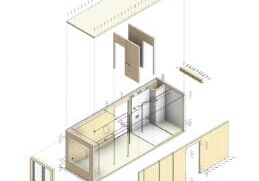
Precision and Possibility: Demands of DfMA and What Modular Mass Timber Makes Possible
Mass timber does not automatically create an efficient modular building. Its precision makes early coordination more important: fabricated components will accurately reproduce both the team’s solutions and its mistakes. The material’s advantages are realized only when supported by an equally precise design and delivery process.
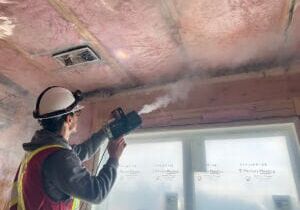
Catch It in the Factory, Not in the Field: Smarter Testing for Modular Builds
Integrating watertightness and airtightness testing into factory workflows transforms quality assurance from a reactive process into a proactive commissioning strategy. It ensures that every module shipped is field ready and resilient for transportation while also supporting the ability of the modular construction industry to make buildings better.
Modular Construction Contracts: Key Considerations for Successful Canadian Projects
Starting a modular project with a well-developed contract protects both the owner and the contractor. It will help keep the project on track and on budget, and it will improve quality from the factory floor to final installation on-site.
Modular by Design: Turning Architecture into a Manufacturing System
Modular construction is often presented as a faster way to build. Speed, however, is only one part of its value. The larger opportunity is to create a coordinated design and production system that improves quality, reduces uncertainty, and allows a building to move efficiently from concept design through manufacturing, transportation, installation, and completion.

Repeatability Begins with Trust: What Alora at Dry Creek Reveals About Scaling Modular Housing
Alora at Dry Creek, a 329-unit, multifamily community comprising five four-story buildings in Centennial, Colorado, demonstrates how repeatable design, standardized manufacturing and early collaboration can work together to create a model that is not only faster to deliver, but easier to replicate across future projects.
T.R. Arnold: The Art of Third-Party Inspections
T.R. Arnold (TRA), a third-party inspection company in Elkhart, Indiana, contracts with modular manufacturers across the US. Manufacturers register with each state to which they intend to send their modules and may be required to hire a third-party inspection company.
Creating an ‘Ecosystem for Innovation:’ 50+ Years of Modular Construction Oversight in Virginia
Virginia’s modular building program began in 1973, with the implementation of the Virginia Industrialized Building Unit and Mobile Home Safety Regulations. Now it’s leading the country in modular code adoption.