
MBI annonce le tout premier programme d'apprentissage industriel en collaboration avec le Marshall Advanced Manufacturing Center

Tom Hardiman, CAE, est directeur général du Modular Building Institute.

Derek Scarbro, directeur général de MAMC, avec Tom Hardiman, directeur général de MBI
Demandez à n'importe quel fabricant quels sont ses trois principaux défis, et il y a de fortes chances que le recrutement et la fidélisation des employés figurent parmi ses réponses.
MBI a récemment conclu un partenariat avec le Marshall Advanced Manufacturing Center (MAMC) afin de proposer à l'industrie des programmes d'apprentissage certifiés par le ministère américain du Travail (USDOL).
En vertu de cet accord, MAMC assurera toute la formation du fabricant, fournira tous les programmes approuvés, les portails de formation en ligne et tous les rapports nécessaires au ministère du Travail à des fins de conformité. MAMC collaborera également avec les écoles professionnelles régionales situées dans la région du fabricant afin de créer un vivier de candidats potentiels.
Tout cela est réalisé dans le cadre d'une subvention fédérale accordée au MAMC et est actuellement proposé sans frais pour l'employeur.
L'apprentissage modulaire « Technicien en fabrication industrielle » est un programme de formation structuré d'une durée d'un an et demi, conçu pour doter les participants des compétences et des connaissances nécessaires pour travailler dans des environnements de fabrication modulaires. Ce programme permet aux fabricants d'offrir un parcours professionnel légitime aux ouvriers d'usine, tout en améliorant leurs compétences et leur efficacité.
Alors que l'industrie modulaire continue de croître en Amérique du Nord, MBI lance une nouvelle initiative visant à garantir que nous disposons d'une main-d'œuvre qualifiée et formée pour tenir la promesse de la construction industrialisée, a déclaré Tom Hardiman, directeur exécutif de MBI.
Le membre du MBI Portable Solutions Group a été la première entreprise à adhérer au nouveau programme.
« Nous sommes fiers d'être les premiers membres du MBI à rejoindre le nouveau programme d'apprentissage de l'industrie », a déclaré Robert Slagel, de Portable Solutions Group (une division de VitalSpace). « Former une main-d'œuvre qualifiée et créer de véritables parcours professionnels n'est pas facultatif, c'est essentiel pour notre entreprise et pour l'avenir de cette industrie. »
Plusieurs autres usines sont intéressées et sont actuellement en pourparlers avec MAMC pour mettre en œuvre le programme. Si votre entreprise est intéressée par ce nouveau programme d'apprentissage ou par d'autres programmes et services de développement professionnel et de main-d'œuvre proposés par MBI, veuillez contacter Heather Packard, directrice du développement professionnel et de la main-d'œuvre chez MBI, à l'adresse heather@modular.org.
Plus de Modular Advantage
MBI Town Halls 2026: Reflections from Boston
By the end of 2026 MBI’s Government Affairs team will have traveled over 6,000 air miles to bring Town Hall events to five different cities in two countries.

Mind the Gap: The Interface Between Onsite and Offsite Construction
Every design for manufacture and assembly (DfMA) project — modular, mass timber, or panelized — is really two projects joined at a seam. One is built in a controlled factory to millimeter tolerances; the other in the field, in weather, to the looser tolerances of poured concrete and human hands. Between them sits an interface: where the factory’s precision meets the site’s reality.
Rules, Rails & Repeatability: Applying DfMA to Modular Healthcare
DfMA offers several advantages for healthcare projects, with faster delivery among the most valuable. Schedule matters when building new facilities, expanding campuses, renovating existing space or bringing care closer to communities that need it.
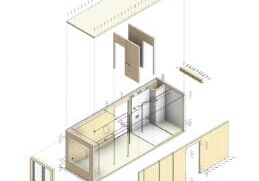
Precision and Possibility: Demands of DfMA and What Modular Mass Timber Makes Possible
Mass timber does not automatically create an efficient modular building. Its precision makes early coordination more important: fabricated components will accurately reproduce both the team’s solutions and its mistakes. The material’s advantages are realized only when supported by an equally precise design and delivery process.
Catch It in the Factory, Not in the Field: Smarter Testing for Modular Builds
Integrating watertightness and airtightness testing into factory workflows transforms quality assurance from a reactive process into a proactive commissioning strategy. It ensures that every module shipped is field ready and resilient for transportation while also supporting the ability of the modular construction industry to make buildings better.
Modular Construction Contracts: Key Considerations for Successful Canadian Projects
Starting a modular project with a well-developed contract protects both the owner and the contractor. It will help keep the project on track and on budget, and it will improve quality from the factory floor to final installation on-site.
Modular by Design: Turning Architecture into a Manufacturing System
Modular construction is often presented as a faster way to build. Speed, however, is only one part of its value. The larger opportunity is to create a coordinated design and production system that improves quality, reduces uncertainty, and allows a building to move efficiently from concept design through manufacturing, transportation, installation, and completion.

Repeatability Begins with Trust: What Alora at Dry Creek Reveals About Scaling Modular Housing
Alora at Dry Creek, a 329-unit, multifamily community comprising five four-story buildings in Centennial, Colorado, demonstrates how repeatable design, standardized manufacturing and early collaboration can work together to create a model that is not only faster to deliver, but easier to replicate across future projects.
T.R. Arnold: The Art of Third-Party Inspections
T.R. Arnold (TRA), a third-party inspection company in Elkhart, Indiana, contracts with modular manufacturers across the US. Manufacturers register with each state to which they intend to send their modules and may be required to hire a third-party inspection company.
Creating an ‘Ecosystem for Innovation:’ 50+ Years of Modular Construction Oversight in Virginia
Virginia’s modular building program began in 1973, with the implementation of the Virginia Industrialized Building Unit and Mobile Home Safety Regulations. Now it’s leading the country in modular code adoption.