
Europe’s Modular Market Is Expanding, but Consistency Still Matters
Europe’s modular construction sector is entering a new phase, shaped by rising demand and familiar industry pressures. According to Alan Milne, European Membership Director for the Modular Building Institute, the forces driving growth are not new, but they are becoming more urgent.
“The market in Europe is a reflection of the global market changes,” Milne said. “There is a need to build high-quality buildings quicker, along with the ongoing shortage of skilled labor.”

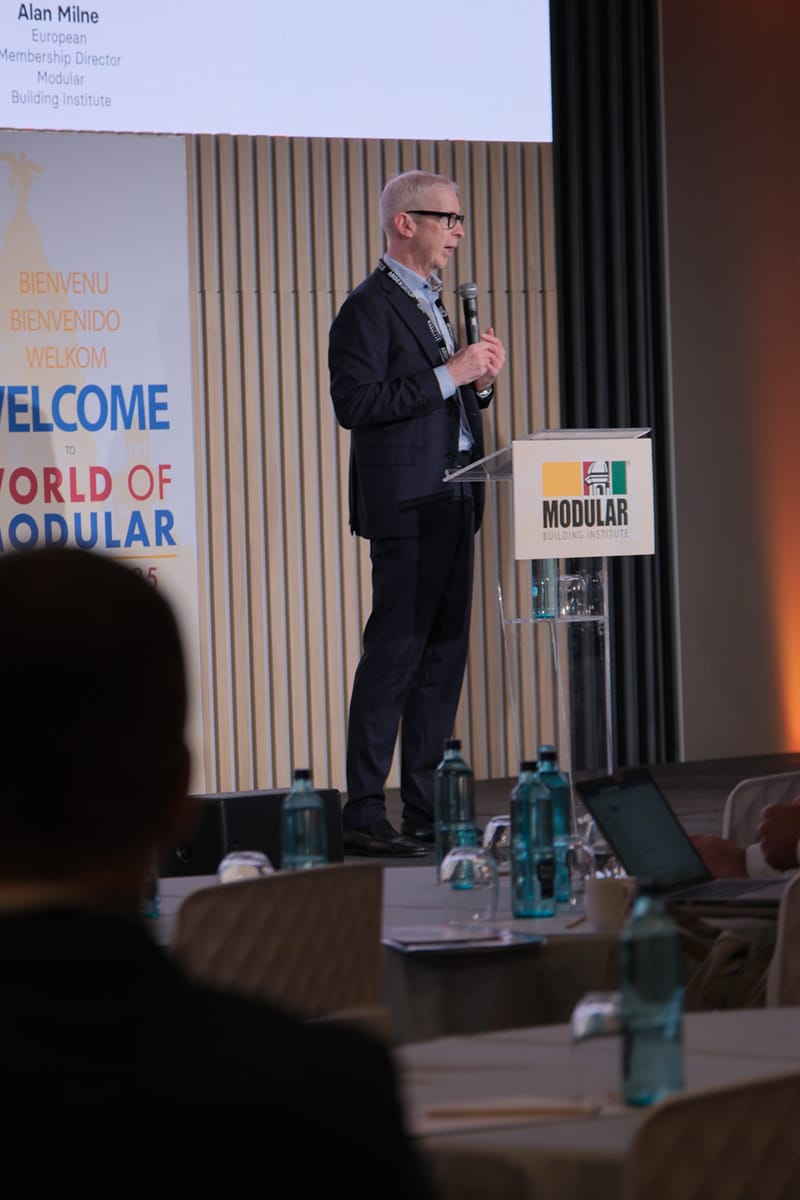
Alan Milne addressed attendees during one of the general sessions at the 2025 World of Modular Europe conference in Madrid.
A Market Defined by Three Key Segments
Milne sees the European market developing across three distinct segments, each contributing to the sector’s expansion.
The first is the industry’s traditional base: office accommodation, healthcare, education, and leisure. These sectors have long relied on modular construction, but perceptions are shifting. “What was once seen as a quick solution is now considered a credible alternative to traditional construction,” he said.
The second segment is housing, where demand continues to accelerate. “The global shortage of housing has pushed modular into the spotlight,” Milne explained. “It allows for the delivery of high-quality homes in a shorter timeframe.”
The third segment includes emerging applications such as data centers. These projects benefit from modular’s ability to deliver precision and flexibility. “You can achieve a high-quality internal fit-out, reduce build times, and allow for easier future expansion,” he said.
Together, these segments show how modular construction in Europe is evolving beyond its traditional role. It is not replacing conventional construction outright, but it is becoming a stronger and more versatile option across multiple sectors.
Regulation and Demand: Challenges to Watch
Still, growth comes with challenges.
One of the most significant is regulatory change across the European Union. Milne pointed to the European Commission’s 2025 single market strategy and updates to the Construction Products Regulation as key developments shaping the industry.
“These changes will impact how companies operate across EU markets,” he said. “There are clear benefits, but also a need for businesses to adapt quickly.”
Milne believes the long-term outlook is positive. “There is potential for easier tendering, reduced paperwork, and better digital compliance systems,” he said. “There will also be a stronger focus on low-carbon materials.”
However, companies will need to prepare. “Manufacturers and supply chains will have to audit their processes, train staff, and integrate new digital tools,” he said. “Keeping up with regulatory updates will be critical.”
A key part of this shift is the Digital Product Passport, which will centralize product data across the EU. Milne sees it as a major step forward. “It will help streamline information and support cross-border business,” he said.
Despite these advances, one persistent issue remains: inconsistent demand.
“The industry needs a steady pipeline of work,” Milne said. “You cannot maintain large manufacturing facilities without confirmed orders.”
Planning delays, especially in housing, continue to disrupt that pipeline. Even so, Milne remains optimistic that regulatory improvements could help stabilize demand over time.
Collaboration and Connection Across Borders
Collaboration, he added, will play a major role in that progress.
“The industry will become stronger working together,” Milne said. “Companies are increasingly open to sharing experience and knowledge.”
He believes a global network is essential in today’s market. “Challenges are not limited to one country,” he said. “Learning from other regions helps companies adapt faster.”
That thinking has shaped MBI’s growing presence across Europe. Milne has hosted in-person meetings in Lisbon, Brussels, and Eindhoven to connect with members and better understand local markets.
“Each country has its own challenges,” he said. “We need that local insight to provide meaningful updates at a European and global level.”
These meetings are designed to encourage open discussion. “The agendas are flexible so people can share their experiences,” Milne said. “We’ve also included local associations to strengthen relationships.”
He expects the effort to expand into additional countries, building a stronger network across the region.
Events also play a central role in connecting the global modular community.
For European companies, Milne sees clear value in attending World of Modular. “The program includes keynote speakers, new products, and breakout sessions that show where the industry is heading,” he said.
But the real value often happens between sessions. “The networking is just as important,” he said. “It’s where companies share knowledge and explore new opportunities.”
He expects similar benefits from MBI’s European event, with a stronger regional focus. “It gives companies more space to discuss issues specific to Europe,” he said.
When asked about MBI’s overall value, Milne pointed to two key factors.
“Industry knowledge and professional opportunity,” he said. “Members gain access to global expertise and a network of leaders and innovators.”
As Europe’s modular market continues to evolve, those connections will become even more important.
The global industry will come together at the 2026 World of Modular, taking place April 20–23, 2026, at the Bellagio Hotel & Casino in Las Vegas. The Modular Building Institute will also host its World of Modular Europe event October 12–14, 2026, in Amsterdam, bringing a regional focus to the same conversations shaping modular construction worldwide.
A propos de l'auteur : John McMullen, PCM, est le directeur marketing du Modular Building Institute. Vous pouvez le contacter directement à l'adresse mcmullen@modular.org ou sur LinkedIn.
Autres articles sur les affaires gouvernementales

La proposition de l'Oregon sur le salaire dominant : Un signal d'alarme pour la construction modulaire
Si le projet de loi 2688A était adopté, les prix des projets de construction augmenteraient, les délais d'achèvement seraient plus longs et la production de déchets serait nettement plus importante. Le projet de loi encourage également l'attribution de contrats à des entreprises étrangères qui ne réinvestiraient pas leurs gains dans l'économie locale de l'Oregon.
Lire l'article complet
Une grande victoire pour l'industrie de la construction modulaire dans le Massachusetts
Au début du mois de février 2024, le Massachusetts Board of Building Regulations and Standards (BBRS) a publié sa proposition de 10e édition des codes de construction. Ce projet comprenait plusieurs amendements visant la construction modulaire qui auraient créé un environnement extrêmement difficile pour l'ensemble du secteur modulaire et auraient pu l'éliminer complètement dans l'État.
Lire l'article complet
La FEMA annonce un plan de logement à Hawaï faisant appel à la construction modulaire
L'Utah devient le deuxième État du pays, après la Virginie, à adopter pleinement les normes 1200 et 1205 de l'ICC/MBI. Le MBI continuera à travailler avec les dirigeants de l'Utah pour mettre en œuvre le nouveau programme.
Lire l'article complet
Les normes 1200 et 1205 de l'ICC/MBI constituent la base du tout premier programme modulaire de l'État de l'Utah
L'Utah devient le deuxième État du pays, après la Virginie, à adopter pleinement les normes 1200 et 1205 de l'ICC/MBI. Le MBI continuera à travailler avec les dirigeants de l'Utah pour mettre en œuvre le nouveau programme.
Lire l'article complet