
Affordable Housing, One Module at a Time

Kristin Field-Macumber is a researcher in the National Laboratory of the Rockies’ (NLR’s) (formerly the National Renewable Energy Laboratory's—NREL’s) Building Energy Systems Integration Research Group
In most areas of the United States, there is not enough affordable housing to meet local needs. In 2025, the shortage was about 4.7 million homes,[1] and that shortage was responsible for multiple economic and social disruptions, ranging from inflated real estate prices to inadequate or nonexistent housing for the workers needed to maintain and grow local economies. New housing construction has not kept up with demand, incomes have not kept up with the cost of living, and mortgage rates remain stubbornly high.[2] In addition, many developers focus on the larger units common in high-end real estate development despite the existing and growing need for smaller and more affordable homes.[3]
Modular construction is an effective strategy for addressing the housing shortage and creating steady jobs.[4] In addition, modules are built in safe, controlled, indoor environments, reduce waste, and eliminate weather-related damage to materials during construction.
For builders and developers, modular factories offer significant scheduling and cost efficiencies compared with traditional site-built construction, regardless of whether the final product is workforce housing, single family homes, or apartment buildings.[5] In addition, because criteria can vary widely from one location to another, modular units are often built to the most stringent standards used by traditional on-site homebuilders. The result is high quality construction in less time and at less cost compared to traditional site-built construction.[6]
According to the National Center for Construction Research and Education, 41% of the nation’s construction workforce is set to retire by 2031.[7] In Colorado, for example, the number of construction tradespeople is rapidly declining at a time when the state is asking the construction industry to double housing production to meet current and future demand. Modular construction can help meet some of that demand.
The following modular housing manufacturers have partnered with the National Laboratory of the Rockies[8] Industrialized Construction Innovation team to demonstrate how factory-built homes are addressing housing shortages, reducing costs, improving quality, and speeding the construction process at different locations around the United States.

Reframe uses robot-assisted assembly and simplified work instructions—sometimes printed directly on the modules—so that even entry-level workers can perform complex tasks and develop transferable skills. Credit: Reframe Systems.
Reframe Systems
Andover, Massachusetts
18,000 square foot factory
Reframe Systems has a goal of building 1 million resilient homes by 2040.[9] Founded by Vikas Enti, Aaron Small, and Felipe Polido, who met while working at Amazon Robotics, the company operates out of an 18,000 square foot microfactory in Andover, Massachusetts. Although microfactories are not novel, rapidly deployable microfactories are. Reframe can transform an empty warehouse into a manufacturing plant that produces building modules in just 100 days, enabling rapid scaling to meet local demand.
Although the timing varies from one jurisdiction to another,[10] design and permitting work for almost any project takes at least 100 days, which means Reframe can sign a deal with potential customers before investing in local manufacturing capacity. This helps to protect the investment in a new facility by guaranteeing an initial pipeline of work as the business becomes more established in the local market.
The founders built an internal software flow to optimize building processes directly from the detailed "digital twin" 3D models they create for each project. These models can also help guide the box-setting process on site and push detailed drawings and directions to operators on the floor and in the field. An internally developed app tracks progress, identifies process bottlenecks, and pushes change requests back to the modeling or architecture teams when issues arise.
The founders’ vision is to develop and refine systems that control every step of the homebuilding process from product design and permitting to "keys in hand." This is possible because Reframe’s operations are built around artificial intelligence (AI) and it owns and controls the entire process of designing and building its homes.

These duplexes at Boulder’s Ponderosa Community Stabilization Project[11], were assembled from modules built by students at the BoulderMOD facility and finished by volunteers from Flatirons Habitat for Humanity. Credit: Flatirons Habitat for Humanity.
BoulderMOD / Boulder Valley School District / Flatirons Habitat for Humanity
Boulder, Colorado
31,375 square foot factory
Boulder, Colorado, a community of more than 100,000 residents at the base of the Rocky Mountains, has long prioritized ensuring that people of all income levels can live and work in the city.[12] Like many American communities, however, Boulder faces the difficult reality that housing costs have risen faster than wages, placing homeownership increasingly out of reach for working families.
Rather than relying on a single policy or program, Boulder pursued a collaborative solution designed to address both the cost of construction and the supply of permanently affordable homes. That effort led to the creation of BoulderMOD,[13] a modular home manufacturing facility developed through an innovative three-way partnership between the City of Boulder, Flatirons Habitat for Humanity, and the Boulder Valley School District.
The City of Boulder provided the facility and long-term policy support; the Boulder Valley School District integrated workforce training into the operation and provided the land to build BoulderMOD; and Flatirons Habitat for Humanity operates the factory and produces the permanently affordable homes. The 31,375 square foot factory reduces construction timelines and controls quality while maintaining the permanently affordable homeownership model that defines Habitat’s work. Once completed, the modules are transported to building sites, set on permanent foundations, and finished like traditional homes. The all-electric factory includes a 333.54 kW flush-mount rooftop solar system that significantly reduces operational costs, and those savings are reinvested directly into the production of additional affordable homes, further strengthening the financial sustainability of the program.

An affordable apartment building under construction in Breckenridge, Colorado, and built with modules from Fading West Development. Credit: Fading West Development.
Le déclin de l'Ouest
Buena Vista, Colorado
110,000 square foot factory
Founded in 2016, Fading West was originally a developer building workforce housing in the small mountain and rural towns near Buena Vista. In some of those towns, such as the Breckenridge, Copper Mountain, and Vail ski resorts, high housing costs forced many workers to live in suboptimal, crowded conditions. In addition, the long, cold, snowy winters made outdoor construction nearly impossible for half the year.
In response to the need for local affordable housing, and with funding from private investors and state loans, Fading West built its 110,000 square foot Buena Vista manufacturing facility in 2021. The facility produces quality modular homes quickly for communities around the state year-round. The company needs at least five units to make a project pencil out, and, although Fading West is not a custom builder, they offer modules for a range of designs, from single-family homes to apartment buildings.
The company has since expanded into Wyoming, Utah, Montana, Texas, and New Mexico, and is partnering with Home/Town Developments, a group of Los Angeles design, building, development, and real estate professionals in Los Angeles, to provide permanent modular homes for victims of the 2025 Palisades and Altadena wildfires. Members of those communities range from ultra-wealthy to middle-class. For that market, Fading West has designs ranging from multi-million dollar five-bedroom homes to 1,200 square foot, two-bedroom models.

The Vederra modular factory in Aurora, Colorado, produces modules to build energy-efficient, attractive, affordable housing in partnership with organizations such as Habitat for Humanity and the Colorado Housing and Finance Authority. The company also offers real-world learning opportunities for high school and college-aged students. Credit: Vederra Modular.
Vederra Modulaire
Aurora, Colorado
140,000 square foot factory
The Vederra modular factory in Aurora, Colorado, produces modules to build energy-efficient, attractive, affordable housing in partnership with organizations such as Habitat for Humanity and the Colorado Housing and Finance Authority. The company also offers real-world learning opportunities for high school and college-aged students. Credit: Vederra Modular
Vederra Modular makes affordable, energy-efficient modules to construct a range of building types, including single and multifamily homes and commercial properties. The company plans to make 100% of its products available to Colorado housing groups to help deliver low-cost, energy-efficient, affordable housing solutions quickly. It has strong relationships with local community organizations and expects to help these groups build the nearly 35,000 units of affordable housing constructed in Colorado between now and 2030.[14] The factory is currently able to produce approximately 350 units per year.
Once it is fully operational, Vederra will employ an estimated 158 local workers and will serve affordable housing organizations and developers in across the western United States. In partnership with Build Strong Education, which partners with Aurora Community College, Vederra provides access and training support on its factory floor, giving students unprecedented access to real-world construction tasks.
These programs are geared toward high school and college-aged students and will grow the trades in Colorado by increasing expertise in modular construction techniques and providing participants with the skills required by the rapidly growing modular construction industry. As a bonus, many of these skills are transferable to traditional building projects.

A 66-unit apartment building at 6200 Broadway in South Los Angeles, California, built with stacked Model/Z modules. Credit: Model/Z.
SoLa Impact
Watts neighborhood of Los Angeles, California (Watts, Compton)
160,000 square foot factory
SoLa Impact is a for-profit family of real estate funds founded by Martin Muoto and Gray Lusk in 2014 and based in South Central Los Angeles. In addition to focusing on its bottom line, the organization aims to produce much-needed quality affordable housing, catalyze local economic development, and provide access to educational opportunities for historically underserved communities.
In 2023, Muoto and Lusk, together with several engineers and executives from the automotive and aerospace industries,[15] founded Model/Z, a separate company that manufactures steel-framed modular apartment units at its factory in the Watts neighborhood of South Los Angeles. Seventy percent of Model/Z employees are from the surrounding community, and about half can walk to work. Model/Z pays them more than the living wage in the area plus benefits.
Model/Z's modules are built from 100% U.S. steel and use other fire-resistant materials that are expected to last 100 years—an important feature given the recent devastating fires in Los Angeles in which Martin Muoto lost his home. Furthermore, Model/Z's Z/Suite software platform uses artificial intelligence to design buildings in minutes not months and Model/Z's volumetric approach to modular manufacturing produces 60%–90% complete, three-dimensional boxes that include plumbing, electrical, and interior finishes. This process means the company can construct a 70-unit apartment building in just 12 months, less than half the time it takes for traditional stick-built construction. Unit sizes range from a 315 square foot studio to an 845 square foot 3 bedroom, 2 bath apartment.
Model/Z estimates that its total development cost per unit is roughly 10%–15% less than that of traditional construction in California. The factory can produce about three 1-bedroom units per day per shift. The modules are primarily used to build multifamily apartment buildings quickly and affordably but can also be used for accessory dwelling units.[16]
Conclusions
The five NLR partners described in this article offer five different examples of local modular building factories, sized small, medium, and large, that are quickly and nimbly addressing their regions’ housing needs. All of these solutions also showcase high-performance building practices, AI-driven productivity improvements, and investment in workforce development. Other similar examples exist around the U.S. and the world. The success of these modular factories at addressing housing needs should encourage more stakeholders to follow suit.
This work was authored in part by the National Laboratory of the Rockies for the U.S. Department of Energy (DOE), operated under Contract No. DE-AC36-08GO28308. Funding provided by U.S. Department of Energy Building Technologies Office. The views expressed in the article do not necessarily represent the views of the DOE or the U.S. Government. The U.S. Government retains and the publisher, by accepting the article for publication, acknowledges that the U.S. Government retains a nonexclusive, paid-up, irrevocable, worldwide license to publish or reproduce the published form of this work, or allow others to do so, for U.S. Government purposes. Reference herein to any specific commercial products, process, or service by trade name, trademark, manufacturer, or otherwise, does not necessarily constitute or imply its endorsement, recommendation, or favoring by the U.S. Government or the Alliance for Energy Innovation LLC (Alliance). The views and opinions of authors expressed in the available or referenced documents do not necessarily state or reflect those of the U.S. Government or Alliance.
[1] https://www.uschamber.com/economy/the-state-of-housing-in-america
[2] https://fortune.com/article/current-mortgage-rates-12-16-2025/
[3] https://www.cbreim.com/insights/articles/digging-out-of-the-us-housing-affordability-crisis
[4] https://www.modular.org/2019/07/20/the-modular-solution-to-the-construction-labor-shortage/
[5] https://www.nahb.org/other/consumer-resources/types-of-home-construction/multifamily
[9] https://www.greenbuildermedia.com/blog/benefits-of-resilient-building#/
[10] https://hoverarchitecture.com/building-permit-timelines-explained-how-long-does-it-really-take/
[11] https://bouldercolorado.gov/projects/ponderosa-community-stabilization-project
[12] https://bouldercolorado.gov/guide/affordable-housing-boulder
Plus de Modular Advantage
MBI Town Halls 2026: Reflections from Boston
By the end of 2026 MBI’s Government Affairs team will have traveled over 6,000 air miles to bring Town Hall events to five different cities in two countries.
Mind the Gap: The Interface Between Onsite and Offsite Construction
Every design for manufacture and assembly (DfMA) project — modular, mass timber, or panelized — is really two projects joined at a seam. One is built in a controlled factory to millimeter tolerances; the other in the field, in weather, to the looser tolerances of poured concrete and human hands. Between them sits an interface: where the factory’s precision meets the site’s reality.
Rules, Rails & Repeatability: Applying DfMA to Modular Healthcare
DfMA offers several advantages for healthcare projects, with faster delivery among the most valuable. Schedule matters when building new facilities, expanding campuses, renovating existing space or bringing care closer to communities that need it.
Precision and Possibility: Demands of DfMA and What Modular Mass Timber Makes Possible
Mass timber does not automatically create an efficient modular building. Its precision makes early coordination more important: fabricated components will accurately reproduce both the team’s solutions and its mistakes. The material’s advantages are realized only when supported by an equally precise design and delivery process.
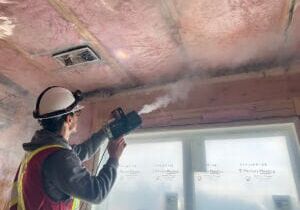
Catch It in the Factory, Not in the Field: Smarter Testing for Modular Builds
Integrating watertightness and airtightness testing into factory workflows transforms quality assurance from a reactive process into a proactive commissioning strategy. It ensures that every module shipped is field ready and resilient for transportation while also supporting the ability of the modular construction industry to make buildings better.
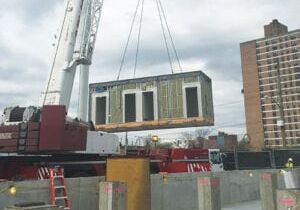
Modular Construction Contracts: Key Considerations for Successful Canadian Projects
Starting a modular project with a well-developed contract protects both the owner and the contractor. It will help keep the project on track and on budget, and it will improve quality from the factory floor to final installation on-site.
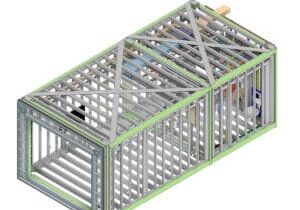
Modular by Design: Turning Architecture into a Manufacturing System
Modular construction is often presented as a faster way to build. Speed, however, is only one part of its value. The larger opportunity is to create a coordinated design and production system that improves quality, reduces uncertainty, and allows a building to move efficiently from concept design through manufacturing, transportation, installation, and completion.
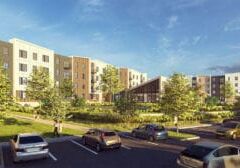
Repeatability Begins with Trust: What Alora at Dry Creek Reveals About Scaling Modular Housing
Alora at Dry Creek, a 329-unit, multifamily community comprising five four-story buildings in Centennial, Colorado, demonstrates how repeatable design, standardized manufacturing and early collaboration can work together to create a model that is not only faster to deliver, but easier to replicate across future projects.

T.R. Arnold: The Art of Third-Party Inspections
T.R. Arnold (TRA), a third-party inspection company in Elkhart, Indiana, contracts with modular manufacturers across the US. Manufacturers register with each state to which they intend to send their modules and may be required to hire a third-party inspection company.
Creating an ‘Ecosystem for Innovation:’ 50+ Years of Modular Construction Oversight in Virginia
Virginia’s modular building program began in 1973, with the implementation of the Virginia Industrialized Building Unit and Mobile Home Safety Regulations. Now it’s leading the country in modular code adoption.