
Financing the Future of Modular Construction: How Better Capital Strategies Can Help the Industry Scale

Jim Park is the founder of Park Place Lending & Investments Inc.
Modular construction has already proven what many in the building industry are still trying to understand: faster delivery, controlled factory quality, reduced site disruption, improved scheduling, and a more predictable construction process are not future ideas. They are happening now.
Across residential, multifamily, hospitality, healthcare, education, workforce housing, ADUs, and commercial projects, modular construction offers a smarter way to build. But even as the industry continues to advance, one major obstacle continues to slow adoption: financing.
For many modular manufacturers, dealers, developers, builders, and end users, the project itself makes sense. The construction timeline makes sense. The quality makes sense. The demand makes sense. But the capital stack often does not.
That is where the modular industry needs a more strategic conversation.

The Financing Gap Holding Modular Back
Traditional construction lending was built around a site-built model. Lenders are comfortable funding work as it is completed on-site, inspected in stages, and attached to the real property along the way. Modular construction changes that process.
A significant portion of the construction occurs off-site, inside a factory. Materials are purchased earlier. Labor is performed earlier. Modules may be substantially complete before they are delivered to the project site. This creates a timing mismatch between how modular projects are built and how many lenders prefer to release funds.
That mismatch can create real challenges:
- Factory deposits may be due before traditional construction funds are available.
- Progress payments may be needed while the collateral is still off-site.
- Borrowers may qualify for the completed project but struggle to access capital at the right time.
- Manufacturers may be asked to carry too much financial burden during production.
- Developers may delay projects because the financing structure does not align with the modular construction schedule.
In other words, the issue is not always project feasibility. Often, the issue is capital design.
Related Listening:
How Financing Companies Can Leverage AI to Help Modular Developers Build Faster w/ Park Place Lending Inc.
Financing can kill a great modular project long before the first module is built. That’s exactly where AI is starting to change the game. Jim Park, founder of Park Place Lending, talks about how AI is impacting financing for commercial modular construction, and the real-world bottlenecks that keep good ideas from turning into funded projects.
Modular Projects Need Modular Capital Thinking
The best financing strategy for a modular project starts before the loan application. It starts with understanding the full project path from design to delivery, site work, production, transportation, installation, and certificate of occupancy.
A strong modular financing package should clearly explain five things:
- Who is building the modules and what is their experience?
- What portion of the work happens in the factory versus on-site?
- What deposits and progress payments are required by the manufacturer?
- What protections are in place for funds released before delivery?
- How will the project be valued upon completion?
When lenders understand these details, the conversation becomes more productive. Modular builders and manufacturers should not assume that every lender understands factory-built construction. Many do not. The best approach is to educate the lender with a clear, professional package.
That package should include the contract, scope of work, production schedule, site-work budget, delivery timeline, installation plan, insurance requirements, permits, appraisal support, and a clear explanation of how funds need to move.

Residential Modular and ADU Financing: The Home Equity Opportunity
One of the most important growth areas in modular construction is the residential ADU market. Homeowners want rental income, multigenerational housing, guest space, home offices, and long-term property value. Modular ADUs can be an excellent solution because they offer speed, quality control, and reduced disruption compared to many traditional construction options.
But homeowners often run into one problem: equity.
A homeowner may have a great low-rate first mortgage and may not want to refinance into a higher rate. A traditional cash-out refinance may not make sense. A standard HELOC may not provide enough funds if the current property value does not reflect the future value created by the ADU.
This is where future-value financing can be powerful.
For certain qualified homeowners, a renovation HELOC or future-value equity strategy may allow the borrower to use the projected after-renovated value of the property. This can help unlock more funding for an ADU or renovation without replacing the existing first mortgage.
For homeowners who already have sufficient equity, a fast digital HELOC can also be a strong option. In some cases, qualified borrowers may be able to access a streamlined HELOC solution designed for speed, simplicity, and convenience.
There is also a third category worth understanding: no-monthly-payment home equity options. These are not traditional HELOCs. They are generally structured as home equity investment or home equity agreement products. For homeowners who cannot comfortably take on another monthly payment, this type of option may provide access to equity without a required monthly loan payment. It must be explained carefully, because repayment is typically based on the agreement terms and future home value. But for the right homeowner, it may solve a real affordability problem.
The key lesson for modular ADU professionals is this: do not assume a homeowner only has one financing path. The better question is, “Which capital strategy matches the homeowner’s equity, income, monthly payment tolerance, and long-term plan?”
Commercial Modular Financing: Build the Capital Stack Early
Commercial modular projects have their own funding challenges. Whether the project is healthcare, hospitality, education, workforce housing, multifamily, office, or temporary relocatable space, the capital structure should be discussed early.
The biggest mistake is waiting until the project is ready to move into production before solving financing.
A better approach is to build the capital stack during the planning stage. That may include senior debt, private capital, bridge financing, construction financing, equipment or modular unit financing, investor equity, or project-specific funding sources.
For commercial modular projects, lenders and capital partners will typically want to understand the sponsor, site control, entitlements, permits, takeout strategy, lease or revenue assumptions, project budget, timeline, manufacturer contract, general contractor role, insurance, and exit plan.
The more complex the project, the more important it is to prepare a lender-ready file. A strong file does not just say, “This is modular.” It explains why the modular method reduces timeline risk, improves execution, and supports the project’s economics.
Best Practices for Modular Builders and Manufacturers
The modular industry can improve financing outcomes by standardizing how projects are presented to capital providers. Here are practical steps that can help:
- Create a financing summary for each project. This should include project type, location, borrower or sponsor, total project cost, factory contract amount, site-work amount, requested financing, estimated completed value, timeline, and exit strategy.
- Separate factory costs from site costs. Many lenders need to see exactly what is being funded off-site versus on-site.
- Document the manufacturer’s process. Include production milestones, payment schedule, quality-control standards, delivery terms, and insurance coverage.
- Prepare appraisal support. Modular projects can be misunderstood if the appraiser does not have clear comparable data, plans, specifications, and completed-value assumptions.
- Address collateral protection. If funds are released while modules are off-site, the lender may need evidence of insurance, title protections, security interests, or other safeguards.
- Bring financing into the conversation early. The earlier funding is discussed, the fewer surprises occur later.
A Better Future for Modular Requires Better Funding Education
The modular industry does not need to convince the market that speed, efficiency, and quality matter. The market already wants those things. What the industry needs now is more education around how to finance modular correctly.
When builders, manufacturers, developers, lenders, and brokers work together earlier, projects move faster. Homeowners get clearer options. Developers can plan with more confidence. Manufacturers can reduce friction around deposits and progress payments. Lenders can better understand risk. And the modular industry can continue scaling into the markets that need it most.
The future of construction will not be solved by one product, one lender, or one financing model. It will be solved by matching the right project with the right capital strategy.
That is the opportunity in front of us.
Modular construction is already changing how we build. Now the financing side must evolve to support it.
For modular builders, manufacturers, developers, and homeowners looking for strategic funding options, visit parkplacelending.com or contact jim@parkplacelending.com.
Plus de Modular Advantage
MBI Town Halls 2026: Reflections from Boston
By the end of 2026 MBI’s Government Affairs team will have traveled over 6,000 air miles to bring Town Hall events to five different cities in two countries.
Mind the Gap: The Interface Between Onsite and Offsite Construction
Every design for manufacture and assembly (DfMA) project — modular, mass timber, or panelized — is really two projects joined at a seam. One is built in a controlled factory to millimeter tolerances; the other in the field, in weather, to the looser tolerances of poured concrete and human hands. Between them sits an interface: where the factory’s precision meets the site’s reality.
Rules, Rails & Repeatability: Applying DfMA to Modular Healthcare
DfMA offers several advantages for healthcare projects, with faster delivery among the most valuable. Schedule matters when building new facilities, expanding campuses, renovating existing space or bringing care closer to communities that need it.
Precision and Possibility: Demands of DfMA and What Modular Mass Timber Makes Possible
Mass timber does not automatically create an efficient modular building. Its precision makes early coordination more important: fabricated components will accurately reproduce both the team’s solutions and its mistakes. The material’s advantages are realized only when supported by an equally precise design and delivery process.
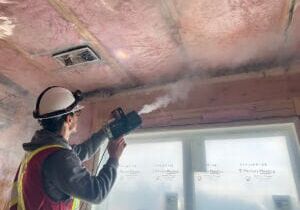
Catch It in the Factory, Not in the Field: Smarter Testing for Modular Builds
Integrating watertightness and airtightness testing into factory workflows transforms quality assurance from a reactive process into a proactive commissioning strategy. It ensures that every module shipped is field ready and resilient for transportation while also supporting the ability of the modular construction industry to make buildings better.
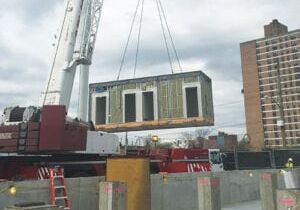
Modular Construction Contracts: Key Considerations for Successful Canadian Projects
Starting a modular project with a well-developed contract protects both the owner and the contractor. It will help keep the project on track and on budget, and it will improve quality from the factory floor to final installation on-site.
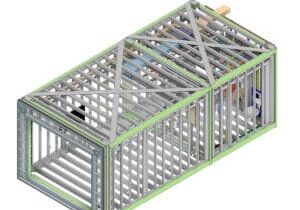
Modular by Design: Turning Architecture into a Manufacturing System
Modular construction is often presented as a faster way to build. Speed, however, is only one part of its value. The larger opportunity is to create a coordinated design and production system that improves quality, reduces uncertainty, and allows a building to move efficiently from concept design through manufacturing, transportation, installation, and completion.
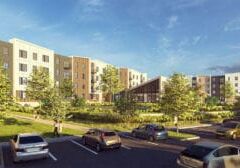
Repeatability Begins with Trust: What Alora at Dry Creek Reveals About Scaling Modular Housing
Alora at Dry Creek, a 329-unit, multifamily community comprising five four-story buildings in Centennial, Colorado, demonstrates how repeatable design, standardized manufacturing and early collaboration can work together to create a model that is not only faster to deliver, but easier to replicate across future projects.

T.R. Arnold: The Art of Third-Party Inspections
T.R. Arnold (TRA), a third-party inspection company in Elkhart, Indiana, contracts with modular manufacturers across the US. Manufacturers register with each state to which they intend to send their modules and may be required to hire a third-party inspection company.

Creating an ‘Ecosystem for Innovation:’ 50+ Years of Modular Construction Oversight in Virginia
Virginia’s modular building program began in 1973, with the implementation of the Virginia Industrialized Building Unit and Mobile Home Safety Regulations. Now it’s leading the country in modular code adoption.